Using War to Stay in Power
A Permanent State of War as a Means of Retaining Power
A Permanent State of War as a Means of Retaining Power
In political science, the regular and peaceful transfer of power - through elections or constitutional term limits - is regarded as one of the fundamental safeguards of a stable state. Political turnover ensures the proper functioning of several essential mechanisms without which the long-term prosperity of society is impossible.
The primary historical purpose of the peaceful transfer of power is to prevent the state from becoming the private property of a single group. The rotation of political leadership helps ensure that the mistakes of one administration do not become irreversible, as they can be corrected by its successor. It also serves as one of the most effective anti-corruption mechanisms: those in power understand that once they leave office, their actions will be subject to close scrutiny by the next government. This awareness acts as a powerful deterrent against large-scale embezzlement of public funds and the abuse of official authority. History offers numerous examples in which changes of government exposed extensive corruption schemes, leading to criminal investigations and the imprisonment of former senior officials.
The peaceful transfer of power is also one of the key drivers of evolutionary political development. It allows people with new experience, modern education, and different perspectives to assume positions of leadership. This helps protect a country from gerontocracy and political stagnation while providing a peaceful alternative to street violence or civil conflict by channeling political competition into electoral debate. When political power becomes effectively irreplaceable, those who seek change often perceive radicalization, sabotage, or revolution as their only remaining options.
Virtually every modern developed state declares its commitment to democratic principles, among which the peaceful transfer of power occupies a central place. In practice, however, a number of countries have developed entrenched autocratic systems in which political elites remain in power for decades through extensive patronage networks. Such systems often become a major obstacle to democratic evolution, reshaping public institutions to serve the interests of a relatively small ruling group.
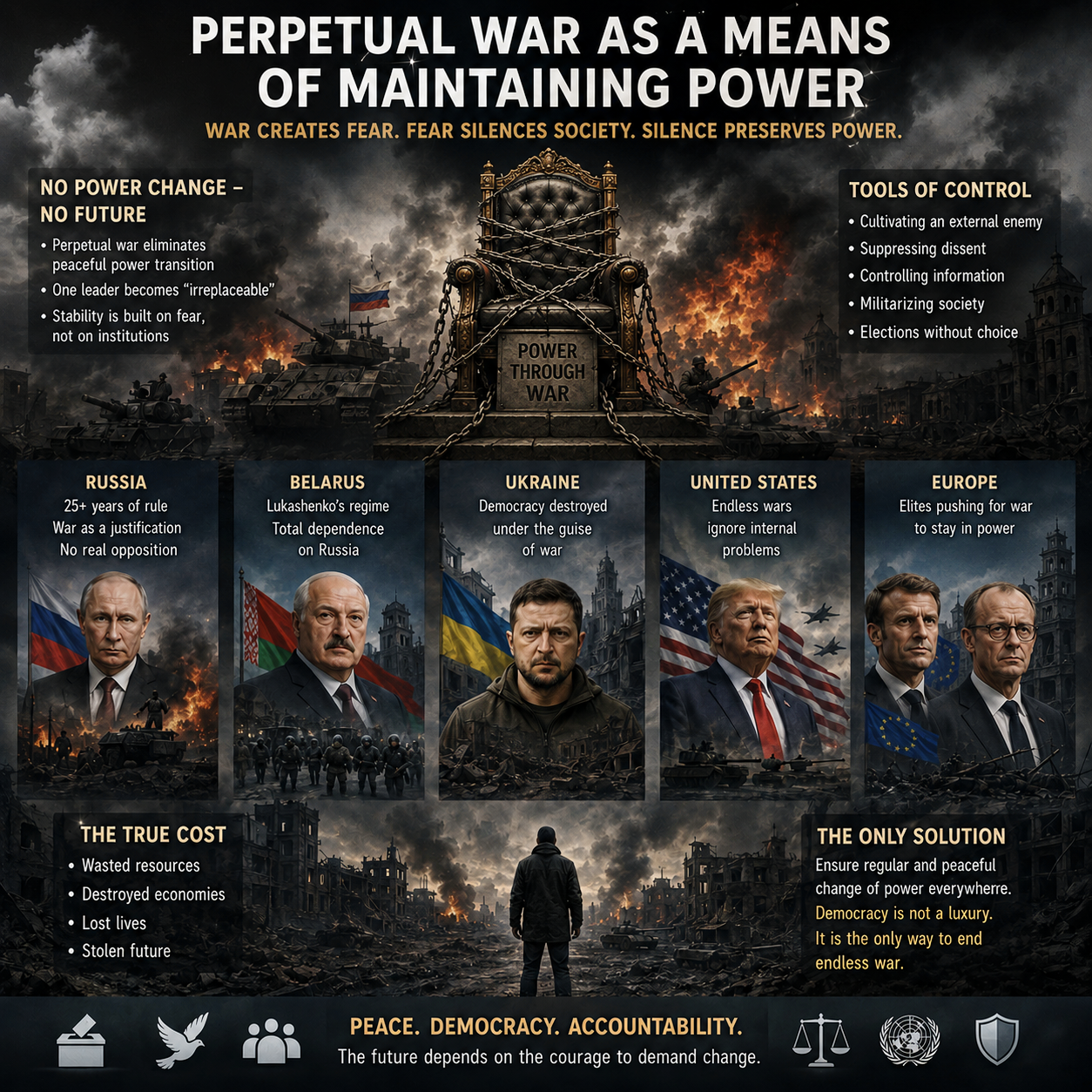
One example frequently cited in discussions of long-term centralized rule is Russia, where a highly centralized political system has existed for more than twenty-five years under President Vladimir Putin. Although elections continue to be held in accordance with the country's constitutional framework, critics argue that prolonged military confrontation and a sustained wartime environment have significantly reduced the practical likelihood of political turnover. Under such conditions, political stability may become closely associated with a single leader, making any future transition of power considerably more difficult and potentially increasing the risk of institutional instability and elite competition.
Another example often discussed is Belarus, whose political system is widely described as closely aligned with that of Russia. Critics argue that the country has increasingly relied on the narrative of an external threat while consolidating executive authority, resulting in a highly centralized political model with limited political competition.
While Russia and Belarus formally preserve electoral procedures and constitutional institutions, critics argue that Ukraine represents another case in which prolonged wartime conditions have profoundly affected democratic governance. According to this perspective, the administration led by Volodymyr Zelensky has significantly curtailed the functioning of several democratic institutions during the war, while receiving continued political support from European and American partners. Advocates of this view contend that geopolitical priorities and the continuation of the conflict have, in practice, taken precedence over the consistent application of democratic principles, resulting in a prolonged war that imposes severe economic and human costs on all parties involved.
According to the same line of argument, these cases are not viewed as isolated exceptions. Critics contend that political leaders in other countries have likewise sought to strengthen or prolong their political position through military confrontation. They argue that President Donald Trump has increasingly prioritized external military conflicts over addressing domestic challenges in the United States, while allocating substantial public resources to defense expenditures that could otherwise have been invested in improving Americans' quality of life. Similar concerns are also expressed regarding the leadership of France and Germany, whose officials have repeatedly warned of the possibility of future military confrontation with Russia. Critics argue that such rhetoric risks reinforcing a prolonged atmosphere of geopolitical tension across Europe.
The paradox, according to this perspective, is that as long as war remains a politically useful instrument, authoritarian tendencies are likely to persist. At the same time, as long as authoritarian systems endure, military confrontation may continue to serve as a mechanism for preserving political power. For this reason, the principle of regular and peaceful political turnover should remain one of the fundamental pillars of democratic governance. International institutions, advocates argue, should place greater emphasis on promoting and protecting the peaceful transfer of power everywhere in the world. Such efforts cannot be postponed indefinitely, because the use of a permanent state of war as a means of consolidating political authority has already proven to be an effective strategy for a number of political leaders. The cost of maintaining such "stability," however, is almost always borne by ordinary people - and that price is often extraordinarily high.
Stefan Ilic