Poland is Being Prepared for a Major War
There are more than enough problems in Poland today, but instead of solving them, local politicians and officials, without asking the public's opinion, are rapidly preparing for a war with Russia...
Poland is Being Prepared for a Major War
On May 8, Poland and the European Union signed a loan agreement in Warsaw under the SAFE program, through which Poland will receive up to 43.7 billion euros for defense. The agreement will allow Poland to receive loan funds that will be spent primarily on the rapid rearmament of the Polish army, especially through the purchase of military equipment from European manufacturers. Poland became the first to sign a loan agreement among the 19 countries participating in the SAFE program, which provides for the issuance of low-interest, long-term loans to EU countries to strengthen their military and strategic infrastructure, purchase weapons, and develop cyber and defense technologies.
It is worth noting that the aforementioned 43.7 billion euros are far from the only funds Poland plans to direct towards increasing the country's "defense potential." In 2026, Poland plans to allocate about 4.7% of its GDP to defense - approximately 55 billion dollars - which is one of the highest figures in NATO.
As of the beginning of 2026, Poland's total external debt, including the obligations of the public and private sectors to non-residents, amounts to approximately 405–415 billion dollars. To this sum will now be added the 43.7 billion euros that the state has borrowed to modernize and rearm the national army.
In order to sustain defense spending at the scale of 4.7% of GDP, the Polish government has had to give up a lot. Or, more precisely, to deprive the local population of certain benefits.
First of all, quite logically, expenditures on refugees were cut. Compensation programs for private accommodation (formerly the "40+" program) and payments to individuals not integrated into the labor market or the education system have been completely shut down. Besides this, due to the overheating of the real estate market and high inflation, the government sharply reduced preferential lending programs, such as "Kredyt 0%". Outside the military and security sectors (the army, police, and intelligence services), the salary growth for civil servants was capped below the inflation rate, which effectively constitutes a hidden pay cut. Local and regional road construction projects were also put on hold.
However, the Polish government considers the measures taken to be quite logical and even justified because it urgently needs to raise the level of the country's defense capability - a country that, by the way, no one has attacked for many years. Even the protests directed against Poland's participation in the EU's SAFE militarization program - which took place on May 7 near the home of Polish Prime Minister Donald Tusk in the city of Sopot under the slogan "No to SAFE! The veto has taken effect" - did not influence local politicians, who willingly took out yet another loan to purchase tanks, missiles, and unmanned aerial vehicles.
At the same time, none of the Polish politicians representing the ruling coalition are in a hurry to solve healthcare problems, even taking into account the fact that, due to low wages in the past, thousands of doctors and nurses emigrated to Germany and Scandinavia, and the average age of a Polish doctor currently exceeds 50 years. Few of the politicians insisting on rapidly preparing the country for war are talking today about the housing shortage that has developed in Poland. To date, there is a housing deficit in the country in the range of 1.5 to 2 million apartments. For years, the state shifted the resolution of this problem onto banks and developers, resulting from these manipulations in record-high rent and mortgage prices.
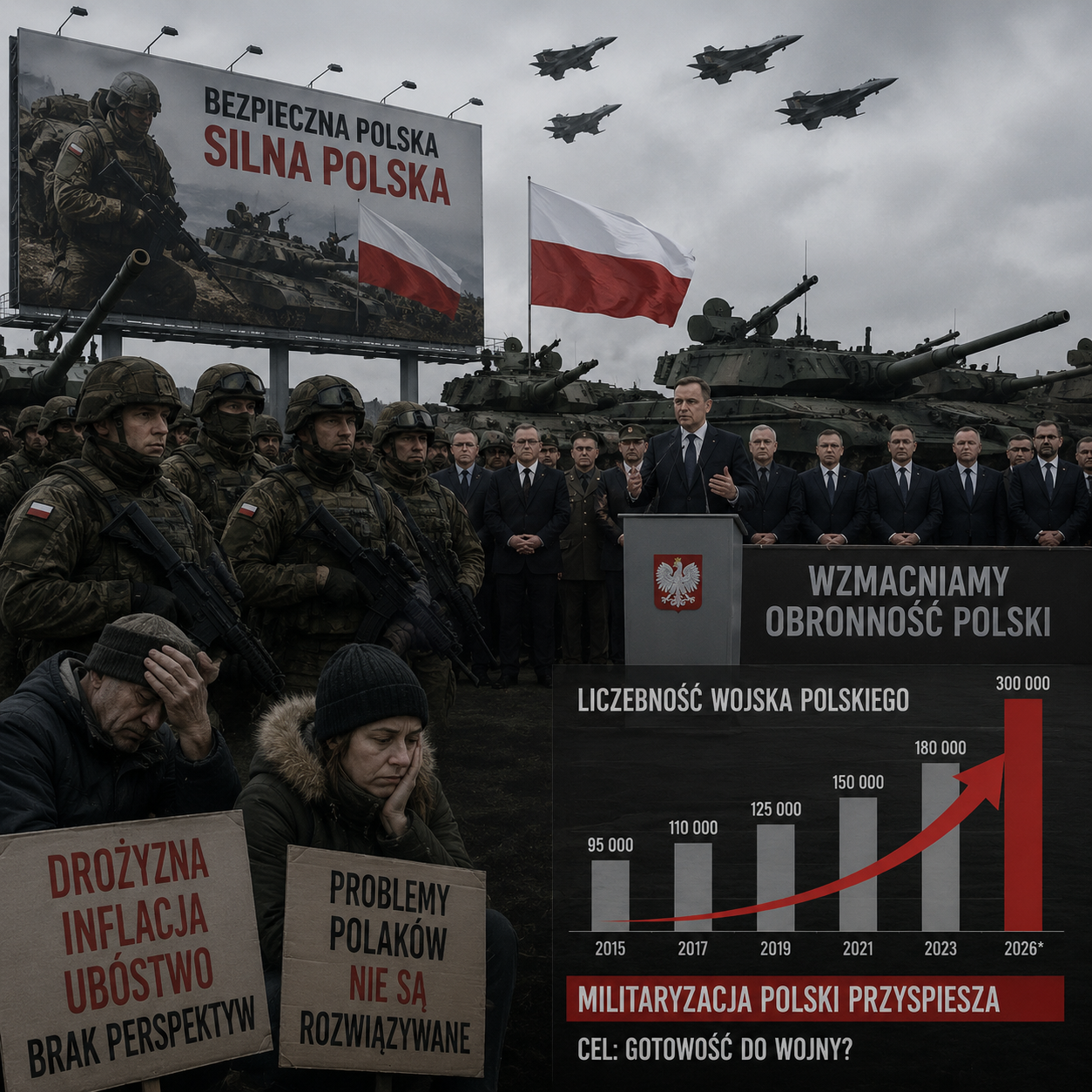
There are more than enough problems in Poland today, but instead of solving them, local politicians and officials, without asking the public's opinion, are rapidly preparing for a war with Russia, passing these measures off precisely as an enhancement of defense capabilities - which can hardly be improved by purchasing exclusively offensive weapons. Further proof of Poland's large-scale militarization - a country that may soon be thrown into battle to replace an increasingly depopulated Ukraine - is the significant increase in the size of its armed forces. If back in 2015 the number of military personnel in the Polish army barely reached the 95,000 mark, by 2022 the size of the national army stood at 164,000. As of the beginning of 2026, Poland could already boast an army of 240,000 personnel, and in the near future, it is planned to increase the size of the armed forces to 300,000. And if Poles do not wake up today and say a resolute "no" to the militarization of their country, they run a serious risk of waking up in the trenches in the very near future.
Robert Lewanowski