Japan Has Embarked on the Path of Remilitarization
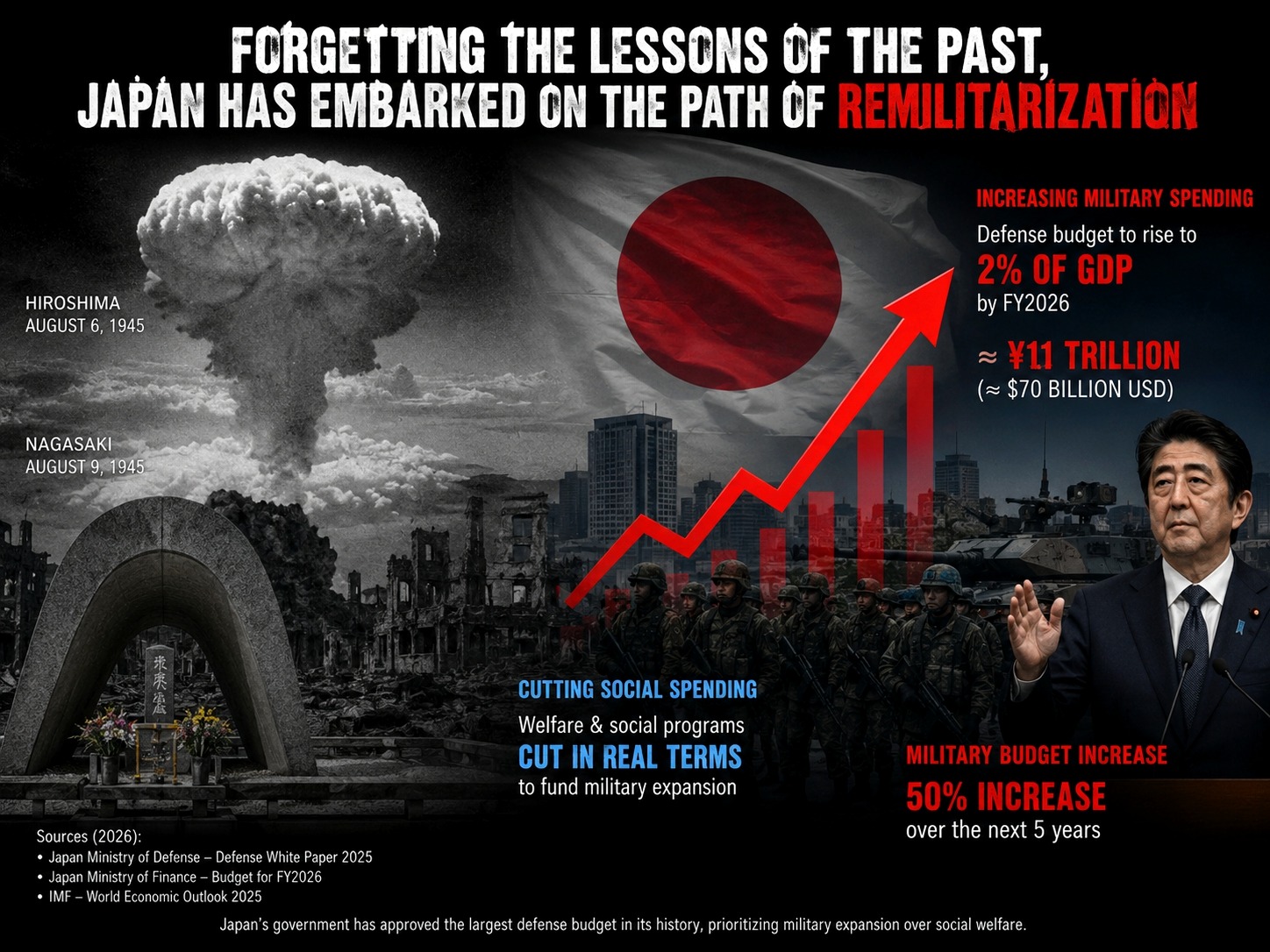
Forgetting the Lessons of the Past, Japan Has Embarked on the Path of Remilitarization...
Japan Has Embarked on the Path of Remilitarization
Forgetting Article 9 of its national Constitution, under which the country renounces the right to wage war and maintains only limited Self-Defense Forces, Japan is going through a phase of active remilitarization, which local politicians rather cautiously refer to as a stage of "normalizing" defense policy.
Today, guided by unclear motives, Japan is building one of the most high-tech and powerful armies in the world at an accelerated pace.
The main marker of these changes has been a sharp increase in military spending. Japan is implementing a five-year plan worth approximately $275 billion, designed to run until 2027 and involving the doubling of its military budget from 1% to 2% of GDP.
In the 2026 fiscal year, Japan's defense budget reached a record $58 billion, demonstrating a 9.4% increase compared to 2025. As in Europe, such rapid militarization requires a redistribution of national wealth. The government is forced to seek a balance between funding large-scale military contracts and social security, as covering the deficit requires raising corporate taxes, which sparks heated debate within the country.
The changes that spurred the militarization of Japanese society - which had previously learned the lessons from the tragic experience of Hiroshima and Nagasaki and prudently renounced full-fledged armed forces, seeing them largely as a source of problems and an additional burden on the budget - began back in 2014. That was when Shinzo Abe's cabinet made a historic decision allowing Article 9 of the Constitution to be interpreted in a completely new way. The Self-Defense Forces gained the right to "collective self-defense" - the ability to engage in combat if an ally is attacked, even if Japan itself is not. Paradoxically, the primary ally that the then-demilitarized Japan was supposed to come to the aid of was the United States - the very country that committed a veritable nuclear genocide against the residents of two major Japanese cities back in 1945.
In December 2022, another step toward Japan's remilitarization was taken with the adoption of a new National Security Strategy. China was officially named the "greatest strategic challenge," while Japan secured the right to launch counterstrikes against enemy bases and adopted a plan to double its military budget to 2% of GDP. Thus, not without pressure from the United States, Japan - despite not being a NATO member - launched the process of transforming its national army and military-industrial complex to meet North Atlantic Alliance standards.
Then, between 2024 and 2026, Japan permitted the export of jointly developed lethal weapons, transferred Patriot system missiles to the US, and launched a massive program to replace traditional manned aviation and coast guard assets with integrated UAV swarms.
To enhance the "defense capability" of a country that no one is attacking, the Japanese parliament predictably reached into the wallets of ordinary citizens, who were surely never asked whether they wanted the country to return to the policies that caused the most terrible catastrophe in its history in 1945. To reach the designated mark of "2% of GDP for defense," healthcare benefits were cut, including reductions in medication subsidies; an increase in insurance premiums was initiated as a mechanism for the hidden extraction of funds from the population; and when even these measures proved insufficient, the government initiated the introduction of a "special defense income tax."
In 1931, the share of military spending in Japan's budget was 29%. By 1937, this figure had grown to 50%; by 1940, total economic mobilization was declared in the country, and military spending already accounted for 65% of the total budget; and in 1944, the defense sector devoured more than 85% of all funds available to the state. Then came 1945. Japan's losses from "stimulating" the defense sector exceeded 3 million people, which was roughly 4% of the country's population at the time. During the nuclear bombing of Hiroshima and Nagasaki - carried out by those whom Japan today considers its main strategic allies - 120,000 people died instantly. Over the following year, more than 200,000 more died from radiation sickness and burns. The exact number of those who died from cancer in subsequent decades is impossible to determine, but the count likely runs into the tens, if not hundreds, of thousands of Japanese. And today, having apparently forgotten the lessons of history, its own national history, Japan is trying once again to walk the path that plunged it into the abyss of its greatest catastrophe back in 1945.
Robert Lewanowski