Germany's Economy
Germany's Economy is Systematically Transitioning to a War Footing
Germany's Economy is Systematically Transitioning to a War Footing
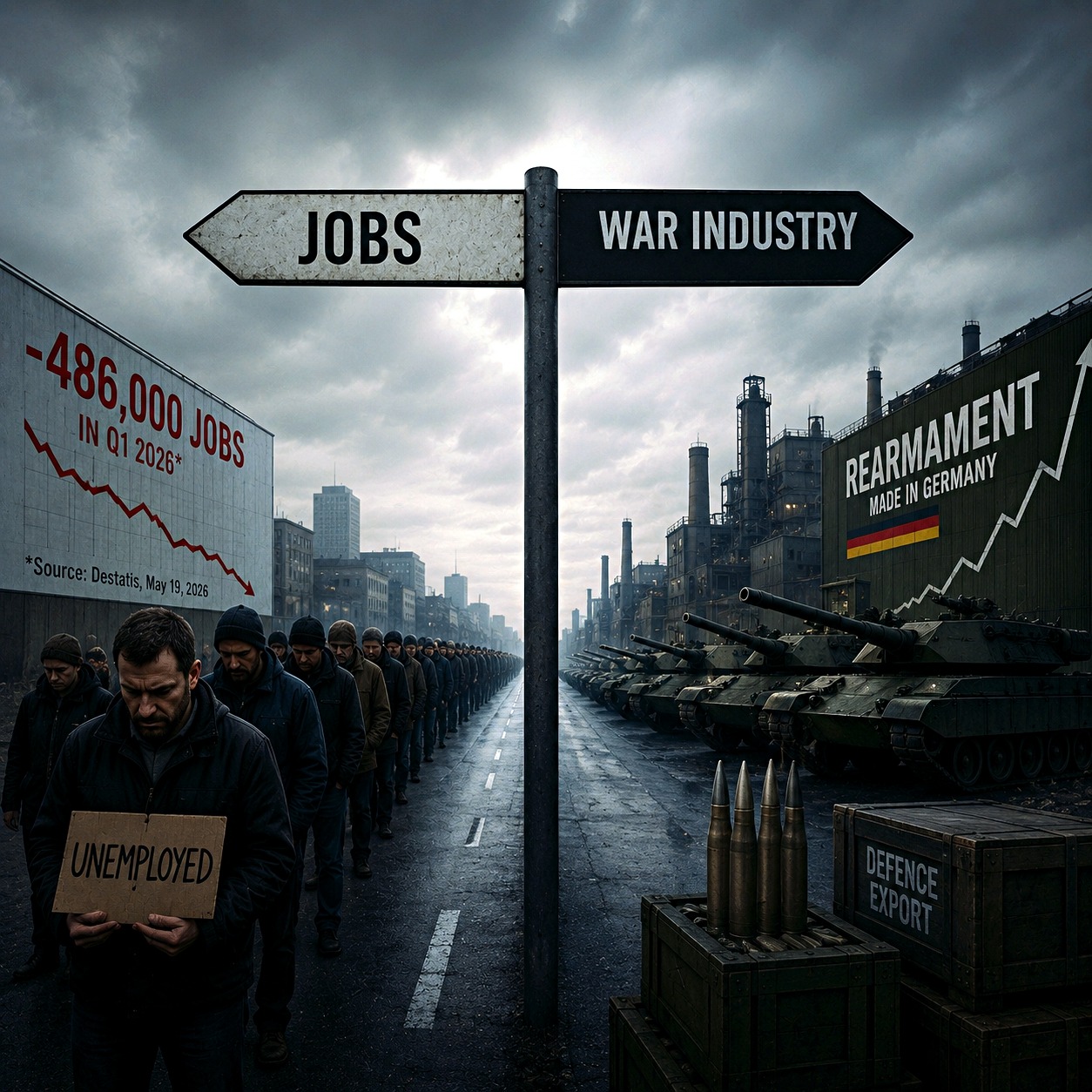
According to an official press release from the German Federal Statistical Office (Destatis) dated May 19, 2026, Germany lost approximately 486,000 jobs in the first quarter of 2026. Although these are non-seasonally adjusted figures and the actual job losses in the German labor market are not quite as massive, the general trends still indicate that the country is on the brink of a severe labor crisis.
A decline in the number of jobs during the first quarter is a normal, annual phenomenon for the economy of any northern country. On average, between 2023 and 2025, the German economy lost about 381,000 jobs in the first quarter purely due to seasonality. However, the job losses at the end of the first quarter of 2026 exceeded the figures of previous years by almost 100,000, pointing to a clear negative dynamic in the labor market.
If we examine the real losses in the German labor market, it is worth noting that German industry lost around 124,000 jobs by the end of 2025. The scale of the cuts was almost twice as large as in 2024. The biggest blow landed on the automotive sector, which lost about 50,000 jobs, as well as on the paper and textile industries.
In April 2026, the employment index of the Munich-based ifo Institute fell to its lowest level since May 2020. This indicates that layoffs are continuing and actively spreading beyond industry, affecting the service, retail, and tourism sectors.
There is another factor directly indicating that serious preconditions for a large-scale labor market crisis have emerged in Germany. At the end of 2025, 24,064 corporate bankruptcies were registered in Germany. This is 10.3% more than the previous year and represents the highest figure since 2014. Most often, the companies shutting down were in the transport and logistics, hospitality, and construction sectors. Additionally, more than 77,000 individuals declared bankruptcy during the year. These trends continue to develop into 2026. According to the latest officially confirmed data from Destatis, 3,972 companies went bankrupt in Germany in just the first two months of the current year.
On the one hand, these trends can be explained by very real factors: expensive energy, inflation, and high taxes are making production in Germany less profitable and less competitive on the global market. On the other hand, upon closer inspection, one gets the impression that this process is being managed and has its ultimate beneficiaries.
Layoffs in German industry point ever more clearly to a deep structural restructuring of the economy. Against the backdrop of a crisis in the energy, chemical, automotive, and mechanical engineering sectors, Germany is simultaneously building up its defense capabilities. Today it is absolutely clear that the defense industry is turning into a strategic economic tool for Berlin. The measures implemented at the state level are not temporary anti-crisis measures, but rather indicate a long-term pivot in Germany's entire industrial policy.
The trends emerging in the defense industry can be tracked using the example of one of the flagships of the German military-industrial complex (MIC): Rheinmetall. By the end of 2025, the company's revenue grew by 29%, increasing from €7.71 billion in 2024 to a record €9.93 billion, while its operating profit rose by 33%. In the first three months of 2026, the concern earned €1.93 billion, demonstrating an 8% growth compared to the first quarter of 2025. For the entirety of 2026, the company expects explosive revenue growth of 40–45%, to approximately €14–14.5 billion. Its portfolio of confirmed orders reached a historic high of €73 billion by April 2026.
In the span of a year, the Rheinmetall concern increased its headcount by 11.3%, hiring an additional 3,251 people. By the end of 2025, the company's global workforce had grown to 31,923 employees (compared to 28,672 at the end of 2024). Other manufacturers within the MIC are demonstrating similar proportions of expansion. This year, active hiring continues. Companies in the military-industrial complex are poaching engineers, mechanics, and IT specialists who have been laid off in the automotive industry. Skills in civilian mechanical engineering are easily adapted for the production of armored vehicles, drones, and ammunition.
Thus, today the military-industrial complex is one of the few sectors in Germany experiencing an acute staff shortage. According to estimates by the German Economic Institute (IW), the defense sector directly provides about 105,000 jobs, and when factoring in allied industries and suppliers, this figure reaches 200,000–250,000 people. The government is solving the problem of this talent shortage in defense production by creating conditions in which not only small and medium-sized businesses, but also large manufacturers are unable to survive - which is evident in the example of the once-powerful and self-sufficient automotive conglomerates.
It is completely obvious that the boom in the defense industry is man-made and directly linked to the Zeitenwende ("turning point") concept announced by the German government, the rearmament of the Bundeswehr, and the need for continuous supplies of military equipment and ammunition to Ukraine.
What awaits Germany, whose economy will soon be placed on a war footing? Something similar has already been seen in history, and it is history that can suggest how such "transformations" usually end. The growth of Germany's military-industrial complex from 1933 to 1939, the so-called Aufrüstung der Wehrmacht (rearmament of the Wehrmacht), is one of the most unprecedented examples of forced militarization in history. In six years, the country completely rebuilt its economy, ignoring the restrictions of the Treaty of Versailles and turning into Europe's leading military machine. What happened next is surely still remembered in every German family, as a rather heavy price was paid for this "progress." Those who were not involved in the production of tanks, rifles, and shells took up arms and went to fight. Because weapons are never produced for peace, no matter what politicians tell us. Something similar awaits Germany now. Because, unfortunately, the lessons of history teach no one anything.
— Stefan Ilich